
The new ranking recently released by the IMD World Competitiveness Center prompts to a host of different inquiries, particularly with respect to the new criteria utilized.
The IMD World Digital Competitiveness Ranking provides a measure of a country’s ability to adopt and explore digital technologies that ultimately lead to transformation in government, business and societal practices. An important factor in assessing this ability of a country is the Future Readiness which reflects the preparedness of an economy to recognize and confront the implied disruptions of the digital technologies.
The Future Readiness factor is dominated by the quantification of the responsiveness of the economic agents to changes. Two of the three sub-factors measure this capacity to comply with a changing environment. Adaptive Attitudes captures the extent to which individuals in an economy accommodate new technologies. From their involvement to issues of government and governance to consumption routines to the ability to ‘connect’ and to reflect on new and different ideas and practices, this sub-factor addresses effectively how accommodating individuals are to new realizations.
Alternatively, businesses’ attitudes are equally important in measuring Future Readiness. Thus, elements related to the firms’ analytic capabilities of big data and knowledge transfer, ability to identify market opportunities, the presence of innovative SMEs as well as the agility of companies allow an economy to be responsive to changes.
The crucial idea is that transformations and disruptions more frequently than not are difficult to map step by step. Consequently, an economy that is highly adaptable and reflective will have, on average, higher probability to successfully address such changes.
If this assumption is valid, a natural implication is that economies that exhibit high levels of adaptability will be more efficient, holding everything else constant. A first step to establish such a relationship will be to examine the association between measures of agility and productivity.
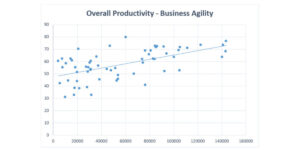
Graph 1 provides the relationship between the Overall Productivity (PPP), an indicator of the IMD World Competitiveness Ranking and the Business Agility sub-factor. The relationship is positive with a correlation coefficient equal to 0.58.
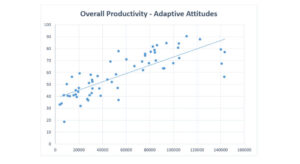
Graph 2 shows the same type of relationship, between the Overall Productivity (PPP) and the Adaptive Attitudes sub-factor. The positive relationship is stronger this time with a correlation coefficient equal to 0.79.
Undoubtedly, more research is needed to establish and support correlations between adaptability and competitiveness. Yet, a simple association between the productivity of an economy and measures of agility exhibits a positive relationship. And this may prove important to decision makers both at the public as well as the private sectors.









Research Information & Knowledge Hub for additional information on IMD publications
Research Information & Knowledge Hub for additional information on IMD publications
Research Information & Knowledge Hub for additional information on IMD publications
Research Information & Knowledge Hub for additional information on IMD publications
Research Information & Knowledge Hub for additional information on IMD publications
Research Information & Knowledge Hub for additional information on IMD publications
Research Information & Knowledge Hub for additional information on IMD publications
Research Information & Knowledge Hub for additional information on IMD publications



Research Information & Knowledge Hub for additional information on IMD publications
Research Information & Knowledge Hub for additional information on IMD publications