
What’s on your mind: the most-read brain circuits of 2025
Our regular series of short articles on the most pressing issues of the moment attracted a good deal of attention this year. Here are the 10 you viewed the most – including...

by Tania Lennon Published February 28, 2024 in Brain Circuits • 3 min read
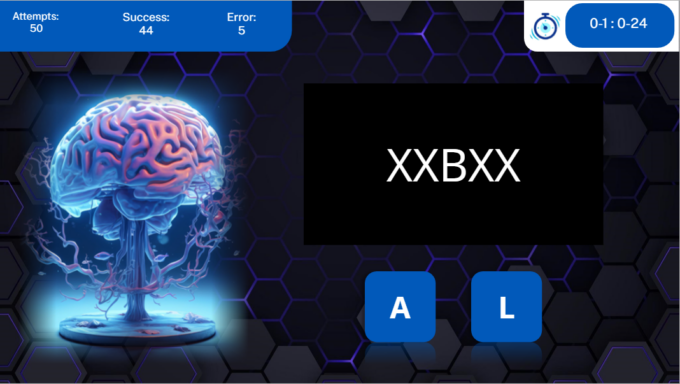
Click here to play the Mind Balance game.
Focus on the middle letter of five to get the answer right.

How did it go? The Mind Balance game is a test of one of the most foundational leadership skills – attentional control. Attentional control is the ability to resist distractors and ignore interference to concentrate on what’s important. It regulates cognitive, emotional, and behavioral choices.
Attentional control has become increasingly important for leaders bombarded by a wealth of information from the digital world. “A wealth of information creates a poverty of attention,” decision-making expert Herbert Simon pointed out in 1971.
At the same time, information abounds, and our jobs are becoming more diverse and heterogeneous. As leaders, we need to switch focus more often which may distract us from deep thought. On top of that, we need to navigate complexity as today’s business environment increasingly involves ambiguous and novel problems with no clear solution.
Without attentional control, we as leaders may be prone to letting our emotions take over and making rash decisions. We may also fail to fully appreciate the key issues in a situation which can also result in poor choices. Attentional control not only helps us perform better but research suggests it also helps us feel better.

“Concentration and mental toughness are the margins of victory.”
What you may have experienced in the Mind Balance game was how susceptible you are to distraction. The accuracy and speed of your choices may have been influenced by the letters on either side of the target. According to Daniel Goleman, improving attentional control can pay dividends across almost every aspect of the leadership role. Goleman (2019) says the key is “diligence – a willingness to exercise the attention circuits of the brain just as we exercise our analytic skills and other systems of the body.”
So how can leaders improve attentional control? Research suggests that one of the most effective methods is through mindfulness. This is a type of mental training to focus attention on experiences in the present moment, which is thought to increase the ability to concentrate effectively (Bishop 2002). Some simple mindfulness techniques include:
Simple steps to improve our ability to focus can help us thrive in dynamic, challenging, and information-rich environments.

Executive Director of the Strategic Talent Development initiative
Tania Lennon leads the Strategic Talent team for IMD. She is an expert on future-ready talent development, including innovative assessment methods to maximize the impact of talent development on individual and organizational performance. Lennon is a “pracademic”, blending a strong research orientation with evidence-based practice in talent development and assessment.

December 16, 2025 in Brain Circuits
Our regular series of short articles on the most pressing issues of the moment attracted a good deal of attention this year. Here are the 10 you viewed the most – including...

December 11, 2025 • by Ginka Toegel in Brain Circuits
AI has the potential to become a super-useful teammate, but CHROs must manage its deployment with care. Answer the questions below to check how employees feel about its adoption and watch out...

December 9, 2025 • by Francesca-Giulia Mereu in Brain Circuits
We’re all familiar with fight, flight, or freeze stress responses. But clinical psychologist Ingrid Clayton identifies a fourth survival strategy lurking in your neural circuitry that most leadership training misses – and...

December 4, 2025 in Brain Circuits
A skills-powered approach to talent management can boost agility, efficiency, and productivity, but transitioning to it is a complex undertaking. Ravin Jesuthasan explains how to get started and identifies the eight pillars...
Explore first person business intelligence from top minds curated for a global executive audience